I vow to assist all beings without exception to attain the Highest Perfect Wisdom
I vow to transcend the endless delusions which hinder the perception of Universal Truth
I vow to learn and actualize the limitless teachings of all Buddhas and Enlightend Beings
I vow to follow unceasingly the Buddha's neverending path.
(per the translation used at the Cloudwater Zendo)

Showing posts with label Cloudwater Zendo. Show all posts
Showing posts with label Cloudwater Zendo. Show all posts
Sunday, May 14, 2006


Saturday, October 29, 2005
Day at an Intensive
Very similar to the "Day of Zen" I attended back in May, the intensive was also held by the local Buddhist group with which I practice under the guidance and teaching of the Venerable Shih Ying-Fa, the abbot of Cloudwater Zendo (our group, Ksanti Sangha, is an affiliate of the Cloudwater temple). Sitting meditation and walking meditation (which we do weekly) as well as work practice, a lunch service, dharma talk/discussion period, and a long chanting service (we normally do a short service in the weekly meetings).
One of the more interesting and revealing exercises was a test of attachment to concepts. We were each given a card with writing on it, with the writing placed face-down. We were instructed to flip the card over and focus our concentration on the word on the other side and observe our minds. I flipped the card and read saw the letters FISH written in print. My initial reaction was a flash of an impression of small dark shapes swimming in the ocean, then the pronounciation of the word FISH, followed by a brief image or impression of a person a boat fishing. Then the word just became letters, F...I...S...H..., and if I had continued concentrating any longer I believe the letters would have turned into lines. We were then instructed to flip the card over and focus on the other side. It was blank--a blank white card. My mind at that point was empty--nothing there to trigger a response.
It's funny, though, that while an intensive is intended to help people strenghten their practice, attempting to gaugue any kind of success or failure is counterproductive on the part of the partcipant as it reinforces some of the very habits, attachments, and midleading concepts from which were are attempting to free ourselves. Having just finished three decades (1978-2005) of being a student in a formal academic setting (elementary school through graduate school) I still sometimes find it hard to not dwell on questions like "I wonder how I'm doing?" or "How do I know if I'm doing it right."
One of the more interesting and revealing exercises was a test of attachment to concepts. We were each given a card with writing on it, with the writing placed face-down. We were instructed to flip the card over and focus our concentration on the word on the other side and observe our minds. I flipped the card and read saw the letters FISH written in print. My initial reaction was a flash of an impression of small dark shapes swimming in the ocean, then the pronounciation of the word FISH, followed by a brief image or impression of a person a boat fishing. Then the word just became letters, F...I...S...H..., and if I had continued concentrating any longer I believe the letters would have turned into lines. We were then instructed to flip the card over and focus on the other side. It was blank--a blank white card. My mind at that point was empty--nothing there to trigger a response.
It's funny, though, that while an intensive is intended to help people strenghten their practice, attempting to gaugue any kind of success or failure is counterproductive on the part of the partcipant as it reinforces some of the very habits, attachments, and midleading concepts from which were are attempting to free ourselves. Having just finished three decades (1978-2005) of being a student in a formal academic setting (elementary school through graduate school) I still sometimes find it hard to not dwell on questions like "I wonder how I'm doing?" or "How do I know if I'm doing it right."
Wednesday, June 29, 2005
Congratulations Tao-Fa
The leader of my sangha is officially being ordained as a novice lay-monk this evening, and I have heard his dharma name will be Venerable Shih Tao-Fa. Tao of course means "Way" or "Path" and in this context Fa means "Dharma". This kind of ordination reflects a serious and deep commitment to serving others. I, on the other hand, continue to be extremely selfish and conceited ;o) . If I ever receive a dharma name it will probably translate into something like "demon bate." So, anyway, congrats again to Tao-Fa and to those who will benefit from his dedication to compassion.
Saturday, May 21, 2005
Day of Zen (actually Ch'an)
From the flier for today's event--
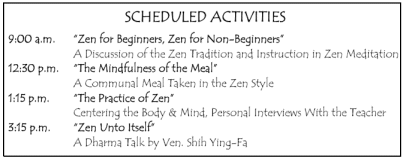
Very beneficial practice, but I need to work on strenghtening my back. And find something better than a chair on which to sit. Unfortunately my long legs don't fit well under most benches. I would probably sit more often if the sitting had a wee bit less discomfort. As for the day of Ch'an (basically they call it Zen in the fliers because few people around here would recognize the name "Ch'an"), I think that one of the highlights was doing one of the walking meditation periods outside. What a site it must have been, two Buddhist monks in full robes followed by half a dozen people in the same posture going single file the main street of one of Pittsburgh's neighborhoods.
Very beneficial practice, but I need to work on strenghtening my back. And find something better than a chair on which to sit. Unfortunately my long legs don't fit well under most benches. I would probably sit more often if the sitting had a wee bit less discomfort. As for the day of Ch'an (basically they call it Zen in the fliers because few people around here would recognize the name "Ch'an"), I think that one of the highlights was doing one of the walking meditation periods outside. What a site it must have been, two Buddhist monks in full robes followed by half a dozen people in the same posture going single file the main street of one of Pittsburgh's neighborhoods.
Thursday, April 14, 2005
Example of a weekly Buddhist service
"Religion will possess strength to the extent that it puts into enduring poetic form the highest values of humanity consistent with empirical knowledge."
--Edward O. Wilson (Biologist, humanist)
While I value being consistent with empirical knowledge, I would suggest religion in fact is a collection of the highest values of humanity in poetic form. Sorry, just pondering my opening quote. Hello? How are you this fine day?
Last night marked the 14th straight week I have gone to a weekly meeting of a local Buddhist sangha. Now, one does not need to go to a sangha to practice, nor is there some special recognition or achievement award for regular attendance. However, keeping the routine is very helpful. So what exactly do we do at these meetings, anyway?
Well, first, we don't have a formal Buddhist temple but we do recreate one with an altar, a stature of the Buddha, flowers, water, candles, and incense along with cushions for sitting. Personal benches and chairs are also available. The person leading the service rings the large bell and the raps several times on the drum to signal the beginning of seated meditation, which lasts 30 minutes. Another strike of the large bell signals the end of the thirty minutes, and when the bell is dampened it signals a seated bow.
A clack of wooden clappers marks the beginning of a ten minute walking meditation and also the end of that meditation, which is followed by bows in all directions accompanied by the small bell. The seats are turned outward and another ring from the large bell and the tapping of the drum signals the beginning of the second 30 minute seated meditation, which, like the first, also ends with a ring of the big bell and a bow when the bell is dampened. Another clack of the wooden clappers to stand once more and turn to the altar for three prostrations, each accompanied by a ringing of the small bell.
Seated once more, the chanting service begins, first with a reading of a purification verse, then a common reading used before reciting sutras referred to as the opening of the sutra. The sutra which follows is the Heart Sutra, which is chanted at one even beat per syllable with the rhythm kept the beating of the drum and punctuated at times by the small bell. The large bell is rung prior to each reading an appropriate number of times, and after the Heart Sutra the readings continue with the four Bodhisattva vows and a dedication of merit. At the end of the reading is a brief chanting session, starting with Namu Dai Bosa and ending with Namo Amitabha Buddha. The meeting ends with a bow.
Amitabha!
--Edward O. Wilson (Biologist, humanist)
While I value being consistent with empirical knowledge, I would suggest religion in fact is a collection of the highest values of humanity in poetic form. Sorry, just pondering my opening quote. Hello? How are you this fine day?
Last night marked the 14th straight week I have gone to a weekly meeting of a local Buddhist sangha. Now, one does not need to go to a sangha to practice, nor is there some special recognition or achievement award for regular attendance. However, keeping the routine is very helpful. So what exactly do we do at these meetings, anyway?
Well, first, we don't have a formal Buddhist temple but we do recreate one with an altar, a stature of the Buddha, flowers, water, candles, and incense along with cushions for sitting. Personal benches and chairs are also available. The person leading the service rings the large bell and the raps several times on the drum to signal the beginning of seated meditation, which lasts 30 minutes. Another strike of the large bell signals the end of the thirty minutes, and when the bell is dampened it signals a seated bow.
A clack of wooden clappers marks the beginning of a ten minute walking meditation and also the end of that meditation, which is followed by bows in all directions accompanied by the small bell. The seats are turned outward and another ring from the large bell and the tapping of the drum signals the beginning of the second 30 minute seated meditation, which, like the first, also ends with a ring of the big bell and a bow when the bell is dampened. Another clack of the wooden clappers to stand once more and turn to the altar for three prostrations, each accompanied by a ringing of the small bell.
Seated once more, the chanting service begins, first with a reading of a purification verse, then a common reading used before reciting sutras referred to as the opening of the sutra. The sutra which follows is the Heart Sutra, which is chanted at one even beat per syllable with the rhythm kept the beating of the drum and punctuated at times by the small bell. The large bell is rung prior to each reading an appropriate number of times, and after the Heart Sutra the readings continue with the four Bodhisattva vows and a dedication of merit. At the end of the reading is a brief chanting session, starting with Namu Dai Bosa and ending with Namo Amitabha Buddha. The meeting ends with a bow.
Amitabha!
Subscribe to:
Posts (Atom)
LinkWithin
