I got the book through Amazon pre-order as soon as it came out then took a month to slowly absorb it rather than my usual 100-200 page a day (or more when I'm off from work) devouring of new books. I have already recommended it over a dozen times, mostly on discussion forums. I would (and have) describe(d) it as a Western Buddhist's (re)discovery of the wisdom of the Bible and Judeo-Christianity.
I am skeptical of Strand's statements in the preface playing down religion because without such tradition, the very insights he found by talking to so many people of different faiths would have been much harder to access. But I suppose that will help those who are hostile to or cynical about religion give the rest of his book a chance. He comes to many of the same conclusion lots of Buddhist converts from Western religions do when we come back to re-examine our heritage, such as the realization of a common Wisdom (confirming an all embracing ineffable Presence and our essential wholeness) that runs through the Old and New Testament in spite of the fundamenalist evangelical form of Biblical exegesis we had previously been blinded by.
Some chapters may require one to be familiar with Buddhism in general, and movements like Nichiren and Shin Buddhism in particular, to fully appreciate, but anyone can get the basic thrust of most chapters. Some are clear about the message Strand has received from a particular passage, and others, such as the one about dancing before the Ark of the Covenant, are more opaque and require a deeper insight on the part of the reader to appreciate. My favorites were the one about evil not having a way and the lesson of Jonah (the peril of having a "Nineveh-moment"). But some may be disappointed that the book does not include references or citations to other works.
A definite recommendation for the religiously progressive or those curious about why a Buddhist might find such inspiration from the Bible. Those who are allergic to "religion" in general and "God" or "Christianity" in particular should avoid this one, because it might wedge a crack in their comfortable prejudices.
To learn more or get this stuff straight from the worst horses's mouth*, try his blog over at Whole Earth God.
(*bad Buddhist pun)

Friday, May 29, 2009


Saturday, May 23, 2009
Mystics under siege by fundamentalists
I consider (apophatic contemplative) mysticism to be a universal denominator for the major sacred traditions, linking "Hinduism", Judaism, Christianity, Islam, Sikhism, Taoism, Buddhism, etc. Reading poetry by Sufi mystics like Rumi will remind you at once of Buddhism and certain strains of Judeo-Christian theology. Apparently, they aren't orthodox or hard-line enough for groups like the Taliban...
PESHAWAR, Pakistan - Worshippers still flock to the grave of Rahman Baba, a Muslim mystic revered by millions in Pakistan and Afghanistan. But they now pray at a mound of rubble and twisted steel — all that remains of his tomb since militants bombed it.
The blast in March was the most high-profile in a recent spate of attacks against Pakistan's homespun, tolerant brand of Islam by hard-liners trying to replace it with the more austere version espoused by the Taliban, al-Qaida and other Sunni extremist groups...
Source
Thursday, May 21, 2009
My profound thought of the week - loneliness

I have come to the conclusion that loneliness, profound and persistent, is the worst fate any human can suffer.
This can include many forms of disconnection - from our past, present, and future. From friends, family, and strangers. From speech, touch, or physical presence. From faith, hope, or love.
So you think can be inspirational
From tonight's premier of Fox's So You Think You Can Dance, judge Nigel Lythgoe has this reaction to routine by a young woman with thoracic chondrodysplasia (the cartilage which would become her thoracic vertebrae didn't form properly, leaving her too few vertebrae and her head essentially sticking out of her shoulders)...
"The bravery that you have to come on a show, like this, is stunning to me. I mean it just--It is one of those things, that -- I mean you've grown up with it all of your life. You've grown up with it so whatever you've had to face, you faced it, and you've moved on in your life. Not only have you moved on and accepted it you've said 'Right, well I'm going to push this body I've been given in ridiculous areas. I'm going to go dancing, I'm going to do this, I'm going to do that.' For the people in this life that sit on their asses and say 'I can't do this', 'I can't do that', 'I can't do the other', they should look at you and be inspired by you."
"The bravery that you have to come on a show, like this, is stunning to me. I mean it just--It is one of those things, that -- I mean you've grown up with it all of your life. You've grown up with it so whatever you've had to face, you faced it, and you've moved on in your life. Not only have you moved on and accepted it you've said 'Right, well I'm going to push this body I've been given in ridiculous areas. I'm going to go dancing, I'm going to do this, I'm going to do that.' For the people in this life that sit on their asses and say 'I can't do this', 'I can't do that', 'I can't do the other', they should look at you and be inspired by you."
Sunday, May 17, 2009

Monday, May 11, 2009
In a world of anger and hatred we are privileged

In a world so torn apart by rivalry, anger, and hatred, we have the privileged vocation to be living signs of a love that can bridge all divisions and heal all wounds.
-Henri Nouwen
We must not wish for the disappearance of our troubles but for the grace to transform them.
-Simone Weil
Saturday, May 9, 2009
Happy Vesak/Buddha Day 2009!
The celebration of the anniversary of the birth of the historical Buddha, Siddhartha Gautama...
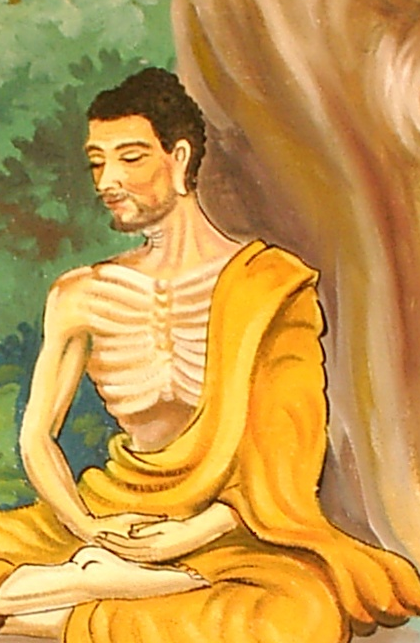
Yeah, this picture would be more appropriate for the holiday in December which celebrates the enlightenment of the Buddha, but I didn't have any pics that are the equivalent of the Buddha's nativity scene. The reason he looks skinny is because at this point in the story of his life he has spent years studying every spiritual practice he could find, every method of earning salvation, every trick for attaining liberation. This included the idea of extreme fasting and mortification. But none of it worked. He mastered every religious ritual, every liturgy, but he still couldn't practice his way into enlightenment. He has just given up fasting and all such methods in the days prior to this image, but he is still emaciated from these techniques. It isn't until he finally lets go, until he finally realizes all his efforts are just expressions of his self-centered worldview, that he cannot ever "achieve" salvation, that he finally has his epiphany. The smile of serenity indicates this has moment has already occurred, so the painting represents the period right after he becomes the Buddha.
Yeah, this picture would be more appropriate for the holiday in December which celebrates the enlightenment of the Buddha, but I didn't have any pics that are the equivalent of the Buddha's nativity scene. The reason he looks skinny is because at this point in the story of his life he has spent years studying every spiritual practice he could find, every method of earning salvation, every trick for attaining liberation. This included the idea of extreme fasting and mortification. But none of it worked. He mastered every religious ritual, every liturgy, but he still couldn't practice his way into enlightenment. He has just given up fasting and all such methods in the days prior to this image, but he is still emaciated from these techniques. It isn't until he finally lets go, until he finally realizes all his efforts are just expressions of his self-centered worldview, that he cannot ever "achieve" salvation, that he finally has his epiphany. The smile of serenity indicates this has moment has already occurred, so the painting represents the period right after he becomes the Buddha.
Sunday, May 3, 2009
The changing tone of (God as presented in) the Bible
I first saw this verse in the film Into Great Silence, a documentary video about life among a group of Carthusian monks...
Take four water bottles. Pour out differing amount of water from each and have the same person blow their breath equally over the top of each bottle. Now take the bottles and freeze them and repeat the experiment. Now crush them and repeat the experiment. The same gentle breath produces wildly different tones depending on the condition of each bottle.
The gentle breath is the Divine. The bottles are individual people. The tones are how people experience the Divine. So some here a loud a violent sound, others a proud and judgmental sound, others mocking a echo. But it isn't the wind that is different, it is the condition of the bottle. In other words, it isn't the Divine that produces these differences, but the state of the individual. The state of the mind, of the heart. Thus some perceive the Divine in one way, and some in another, depending on how well the Divine resonates within them. An obstructed or damaged vessel will not be able to produce a pure sound. And this does not reflect an imperfection in the individual, per se, but rather a limitation in being fully open to the Divine. By the time the sound filters through the doubt, self-centeredness and delusion, if it is heard at all it may sound harsh, or terrible, or shrill. So it's more about losing the obstructions rather than gaining perfection.
This can be expanded to suggest that "the soul" is the lens or perspective through which we experience God, which explains the calls in Judaism and early Christianity to heal or sooth the soul, and it generates some interesting ways to understand terms such as Kingdom of God, Heaven and Hell.
This lens is the aspect of ourselves with which we consciously experience the Divine. It's another way of describing what is discussed above in terms of perception and reception. A wounded soul would be like the damaged vessel through which the Divine may sound harsh, terrible, etc. So healing or soothing the soul would refer to clearing and calming this lens - the depth of the heart. Hence a healed or soothed soul can truly hear/experience the Divine in a more complete, wholesome, and virtuous way.
As mentioned this also has interesting implications for concepts such as the Kingdom of God, Heaven, and Hell, especially as states of being. In Buddhism it is said that the world of suffering and delusion and the world of bliss and perfection are not two separate world but one world. In one state (of delusion) the world is a place of suffering, while in another state (of perfection, or freedom from delusion) is a place of bliss. In one view we only see the worst of ourselves and others, while in another we experience their true wonder and beauty as well as our own, hidden from our normal sight. Which isn't a denial of the horrible things people may do, but rather an insight that this is a tragic aberration born of ignorance of our true natures, a condition which is gradually irresistibly being transformed and overcome.
-------------------------------------------------------------------------
(The following was added months later as an addendum...)
To elaborate then, if you have vengeance in your heart, you will want a God of terrible retribution. Maybe a neighboring culture speaks of such a deity, so you borrow that and add it to your own religion. The Old Testament itself as well as Biblical scholars point to such influences from other cultures in the region. These influences are thought to be responsible for the most repugnant of the images and passages in these part of scripture.
Then there are prophetic passages which imply that our actions have consequences. In this case, it isn't that God is threatening anyone, but saying "Hey, if you do X then Y will come to pass." Sometimes Y is literal and sometimes Y is metaphorical or figurative. But they are warning for our own benefit. Many of the claims for bullying or intimidation in the OT are of this variety. In some cases, God is proactive. In the story of Babel, people like to look at elements like "God had to go down to see the tower" and ask how that makes sense for an omnipresent being. Which of course misses the point - the story isn't a blow for blow recap but a warning about the dangers of vanity. In this case, it is a story that is as relevant today as ever. The people were trying to build a tower to get to God, i.e., to use their cleverness, technology, and other mental gifts to find God. Just like some people today think they can use science to either prove or disprove God, as if God could be contained in human conceptions or formulas. He destroys the tower and scatters the people for their own good. The story also suggests that one language or culture doesn't have a stranglehold on knowing God.
Closely related to this is the most direct point of the lesson about the heart that I mentioned above - in other words, the message is, if you think or act like that, God will (appear to be) like this. Some interpret the scariest pat of the New Testament - the Book of Revelations, in this fashion with the latter perspective. Humans who are ignorant and deluded and sinful will feel they are pitted against God and like God is giving them tribulations and punishments. Because they cannot forgive or open their heart they give in to unreal fantasies and terrors, but in their actions based on such paranoia and distortion they are truly capable of bringing destruction and devastation and a very real hell on earth. Those who surrender their delusion and suffering and enter the Kingdom see the world in a completely new and different way as per the end of Revelations. [See How to Believe in God (Whether or Not You Believe in Religion) for a more complete view of this interpretation.]
And yes, in the place of or in addition to all of this there are those who see the Bible as an ongoing dialogue, a conversation between humans and God, and that as culture's mature the visions of God that are acceptable also changes.
And, behold, the LORD passed by, and a great and strong wind rent the mountains, and brake in pieces the rocks before the LORD; but the LORD was not in the wind: and after the wind an earthquake; but the LORD was not in the earthquake:In the New International Version "still small voice" is translated as "gentle whisper".
And after the earthquake a fire; but the LORD was not in the fire: and after the fire a still small voice.
1 Kings 19:11-12
Take four water bottles. Pour out differing amount of water from each and have the same person blow their breath equally over the top of each bottle. Now take the bottles and freeze them and repeat the experiment. Now crush them and repeat the experiment. The same gentle breath produces wildly different tones depending on the condition of each bottle.
The gentle breath is the Divine. The bottles are individual people. The tones are how people experience the Divine. So some here a loud a violent sound, others a proud and judgmental sound, others mocking a echo. But it isn't the wind that is different, it is the condition of the bottle. In other words, it isn't the Divine that produces these differences, but the state of the individual. The state of the mind, of the heart. Thus some perceive the Divine in one way, and some in another, depending on how well the Divine resonates within them. An obstructed or damaged vessel will not be able to produce a pure sound. And this does not reflect an imperfection in the individual, per se, but rather a limitation in being fully open to the Divine. By the time the sound filters through the doubt, self-centeredness and delusion, if it is heard at all it may sound harsh, or terrible, or shrill. So it's more about losing the obstructions rather than gaining perfection.
This can be expanded to suggest that "the soul" is the lens or perspective through which we experience God, which explains the calls in Judaism and early Christianity to heal or sooth the soul, and it generates some interesting ways to understand terms such as Kingdom of God, Heaven and Hell.
This lens is the aspect of ourselves with which we consciously experience the Divine. It's another way of describing what is discussed above in terms of perception and reception. A wounded soul would be like the damaged vessel through which the Divine may sound harsh, terrible, etc. So healing or soothing the soul would refer to clearing and calming this lens - the depth of the heart. Hence a healed or soothed soul can truly hear/experience the Divine in a more complete, wholesome, and virtuous way.
As mentioned this also has interesting implications for concepts such as the Kingdom of God, Heaven, and Hell, especially as states of being. In Buddhism it is said that the world of suffering and delusion and the world of bliss and perfection are not two separate world but one world. In one state (of delusion) the world is a place of suffering, while in another state (of perfection, or freedom from delusion) is a place of bliss. In one view we only see the worst of ourselves and others, while in another we experience their true wonder and beauty as well as our own, hidden from our normal sight. Which isn't a denial of the horrible things people may do, but rather an insight that this is a tragic aberration born of ignorance of our true natures, a condition which is gradually irresistibly being transformed and overcome.
-------------------------------------------------------------------------
(The following was added months later as an addendum...)
To elaborate then, if you have vengeance in your heart, you will want a God of terrible retribution. Maybe a neighboring culture speaks of such a deity, so you borrow that and add it to your own religion. The Old Testament itself as well as Biblical scholars point to such influences from other cultures in the region. These influences are thought to be responsible for the most repugnant of the images and passages in these part of scripture.
Then there are prophetic passages which imply that our actions have consequences. In this case, it isn't that God is threatening anyone, but saying "Hey, if you do X then Y will come to pass." Sometimes Y is literal and sometimes Y is metaphorical or figurative. But they are warning for our own benefit. Many of the claims for bullying or intimidation in the OT are of this variety. In some cases, God is proactive. In the story of Babel, people like to look at elements like "God had to go down to see the tower" and ask how that makes sense for an omnipresent being. Which of course misses the point - the story isn't a blow for blow recap but a warning about the dangers of vanity. In this case, it is a story that is as relevant today as ever. The people were trying to build a tower to get to God, i.e., to use their cleverness, technology, and other mental gifts to find God. Just like some people today think they can use science to either prove or disprove God, as if God could be contained in human conceptions or formulas. He destroys the tower and scatters the people for their own good. The story also suggests that one language or culture doesn't have a stranglehold on knowing God.
Closely related to this is the most direct point of the lesson about the heart that I mentioned above - in other words, the message is, if you think or act like that, God will (appear to be) like this. Some interpret the scariest pat of the New Testament - the Book of Revelations, in this fashion with the latter perspective. Humans who are ignorant and deluded and sinful will feel they are pitted against God and like God is giving them tribulations and punishments. Because they cannot forgive or open their heart they give in to unreal fantasies and terrors, but in their actions based on such paranoia and distortion they are truly capable of bringing destruction and devastation and a very real hell on earth. Those who surrender their delusion and suffering and enter the Kingdom see the world in a completely new and different way as per the end of Revelations. [See How to Believe in God (Whether or Not You Believe in Religion) for a more complete view of this interpretation.]
And yes, in the place of or in addition to all of this there are those who see the Bible as an ongoing dialogue, a conversation between humans and God, and that as culture's mature the visions of God that are acceptable also changes.
Saturday, May 2, 2009
The me-show
I don't like depictions of "ego" or "the self" as enemy, because it just continues to reinforce a sense of duality that is at the heart of the (potential) problem anyway. That being said, I am still amazed at myself. I had an idea to do something REALLY nice for someone else. But then after all my planning and starting out to do it, I realized there was a problem and I wouldn't be able to do the nice thing after all. And I was upset. Upset that I wouldn't get that good feeling from seeing the reaction of the person who I supposedly was going to do the favor for. It will still about me. Just like those who burden the dying because the grievers are concerned about how losing the person will make them feel, how it will affect their lives. And then I sometimes look back on the virtuous decisions I've made over my life. No drinking, no drugs, no womanizing, no cheating/dishonest shortcuts, no physical violence/fighting, etc. I agree with most of these decisions all them time, and all of these decisions most of the time. Especially the substance issues and the violence. But I realize sometimes I did/didn't do things because of some sense of getting "credit" for my troubles. The idea that my choices will become more and more anonymous and only count of its own virtue sometimes causes a tinge of regret. And when that summons a sense of regret, I know again it was all about satisfying me, even when I was denying myself satisfaction. No wonder my spiritual journey has been so fruitless. Line up to throw stones and tomatoes here.
Subscribe to:
Posts (Atom)
LinkWithin
