This is part of a series reflecting on God-talk and Buddhist terminology. It is an opening to dialogue, not a final word on the subject.
There is a quite a bit of discussion in Western Buddhism about form and emptiness, as these concepts are featured prominently in the Heart Sutra which in turn has a close association with Zen. This invites comparisons between the Buddhist teaching of non-duality and the concepts of transcendence and immanence. The emphasis today is on form.
Form seems simple enough, given the Western emphasis on materialism. Everything that exists can be reduced to some measurable form of matter or energy, so form is anything composed of these things. Many English-language books on Buddhism use this frame of reference as an analogy to explain emptiness by pointing to subtler and subtler forms of energy until one gets to the fuzzy level of what has been dubbed the quantum field (or in some versions the quantum foam), which itself is compared to emptiness.
This can be misleading as it places the emphasis on an external process rooted in a strictly materialist paradigm. It is fine as an analogy, but prudence suggests it is risky and and unnecessary to draw a direct equivalence. Form is a phenomenological concept that precedes any explanation of the basis of what is being described. Form is, in a sense, anything which can be described and is hence born of discrimination and labeling by the mind. Feeling, intuitions, imaginings, logical musings, judgements, and the like are forms as much as tables, chairs, and chew bones.
In other words, whatever mind is or isn't, wherever and however mind originates, it is itself the origin of form.

Showing posts with label Deepak Chopra. Show all posts
Showing posts with label Deepak Chopra. Show all posts
Friday, February 10, 2012


Wednesday, November 25, 2009
Thich Nhat Hahn, Tenzin Guyatso, Deepak Chopra and the like are all full of it
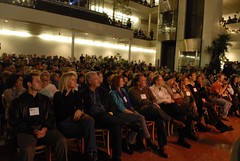 Image by Luiza via Flickr
Just let it out. Those judgments and reactions that scream things such as "It may be pleasant but it's pie-in-the-sky optimism and totally unrealistic. That kind of wishful thinking is hopelessly naive and cannot really work in the real world. It's a kind of sheltered delusion for those who can't cope. It's nice for those in comfort and who have the luxury of Utopian fantasies, but come on! A lot of what he says makes sense but that, that is just ludicrous." Wait until you have uncovered and released something along these lines, then read on below.
It can be hard to do. To admit that part of us thinks that some great leader or teacher that we admire or respect may be a little daft or naive about some things. We may suppress it or find it endearing. Ahh, this part of what she or he believes or advocates is not realistic but we need a good dose of such unfiltered optimism now and then to boost our batteries in a difficult and challenging world. It's an impossible standard, an unachievable ideal, but this individual really deserved to be the standard-bearer for such values. We could all used something or someone to believe in, a bright star to guide our way.
How egotistical and patronizing can you get? These individuals dedicate their lives to living and promoting particular ideals and you poo-poo them as if they were little children. You try to find some way to not take them too seriously on some of their teachings because honestly, only an idiot would really believe them or live by them. By re-framing the teachings. By making them guidelines for aspirations. By suggesting they may have worked for certain cultures and periods of history but not our own. Yikes! I have hit on this before, quoting a letter to President Bush by Hanh. I wrote:
He chose to see Bush as his brother and to appeal to his humanity and his divine/Buddha nature rather than simply mocking him or using angry accusations listing his personal failures and their consequences. So what do we make of this and similar letters, speeches, and other forms of communication? It is certainly something that we can appreciate coming from Thay as he is a world renowned peace activist and Buddhist teacher, but do we really believe that letter, assuming it was received and read, made a difference? And is effectiveness the primary yardstick in cases like this? Do we read things like this and "forgive" Thich Naht Hanh for his simplicity and directness (but also see it as a little naive) because of his status and image? Or is he on the right track, and if so, in what way should we follow his example?
In particular for those who are opposed to the occupation of Iraq and those who capitalized on it politically or financially...
Can you see yourself writing a letter like that to George W. Bush? To Dick Cheney? To the David Lesar, President and CEO of Halliburton? To Erik Prince, founder and owner of Blackwater Worldwide? For the Pro-Iraq war visitors, same question but fill in the names with Nancy Pelosi, or Hillary Clinton, etc.
Or to be really blunt - does such wording make the author sound like a spacey, out-of-touch, overly naive optimist who needs a reality check and to get involved in really making a difference rather than expressing futile sentimentality? Again, I know many or probably most of you might not think that about Thich Nhat Hahn, or if the letter had come from the Dalai Lama, but what if had come from a New Age guru running a crystal therapy center? Or from a Wiccan college freshman taking a course on globalization? Or from your own desk (assuming you are not a New Age guru running a crystal therapy center or a Wiccan college freshman taking a course on globalization)? That is, if you respect Thay's letter and approach, is it because you respect him or because you respect his letter and approach?
I recently suggested something similar along these same lines:
What do you think of when you hear things like "Everything is sacred" or "Each moment is only one moment expressed in infinite ways" or "Every day, every experience, is a gift, even if we don't always appreciate it or know what to make of it." (Yes, I came up with them myself, so smirk if you wish.)
A common reaction in Western (-influenced) societies is to be cynical. It sounds like nice pop psychology for the naive and the desperate or soft spiritualism for the well-healed. But for the savvy individual who lives in "the real world" of work, pain, and disappointment, it can come across as just so much nonsensical overly optimistic fluff.
Yes, perhaps we want to believe, and we may even think we believe it, but do we? Really? Our daily lives betray our underlying assumptions and the beliefs that drive them. How many of us live the life of the cynic, underneath the wrist malas or the shaved head or the polite and thoughtful exterior? These things are just another layer of the false self trying to be holy. There is a universe of difference between trying to be holy and just being holy. Or sacred. Or Christ-like, Buddha-esque, etc.
So to really believe, to really take the teachings seriously, we have to first be brutally honest about our cynicism, our hesitation, our lack of faith. It is a crucial step. And it isn't just a one time catharsis. We have to live with the doubt even as we live as if we possess certainty. Otherwise we are just building more layers of wannabe holiness on a doomed foundation. It is the only way to REALLY come to terms with and accept these counter-intuitive teachings. Until then, no matter how much we might want to protest, our gurus and wise men will, in our heart of hearts, still be full of it and we will by extension remain patronizing hypocrites.
(Addendum: There is nothing that says that these people can't occasionally BE full of it for real; either way, the best way to deal with such suspicions and hesitations is honestly.)
_________________________________________________
*Tenzin Gyatso is the name of the 14th Dalai Lama

Tuesday, November 17, 2009
Deepak Chopra's latest book: The Ultimate Happiness Prescription
 Image by Yodel Anecdotal via Flickr

Sunday, June 7, 2009
Western Buddhists - stay or go home?
Tricycle's Blog recently quoted a sentiment I have run across several times, including a few times from this one individual...
I replied with the following...
If you aren’t ready or able to see the use of returning to your religion of ancestry, then do not. The advice doesn’t just say “Go back.” It says to be healed first, implying growing and dealing with the attachment, confusion or pain previously associated with that ancestral religion and to use the insights from Buddhist practice to find what may have been previously overlooked in your old faith. I would venture to suggest that such reconciliation, in part or total, would eventually be necessary an inevitable even if one stayed on the Buddhist path. Just because you can’t appreciate that being possible now doesn’t mean it cannot happen. No need to force or rush anything or to presume where your path will lead. It will be alright and guide you just where you needed to be. :^)
The thing is, I can see how my experience with Buddhism has impacted my view of Judaism and Christianity, opened my eyes to the contemplative and mystical dimensions of Christianity and neglected but traditional forms of exegesis. The ideas of apparent paradox, the importance of the tension between literal and figurative meanings, the value of ahistorical truth, etc, have been amazing on my appreciation of Christianity. I share the excitement and enthusiasm of people like Clark Strand in (re)discovering the wisdom and compassion of the Bible, even if I am not on his level of insight (see my review of his book on the subject). Books like Going Home: Jesus and the Buddha as Brothers as well as the work and writings of Christians like Br. Wayne Teasdale, Br. David Steindl-Rast, Fr. Thomas Merton, Fr. Thomas Keating, and those saints (official and unofficial) who inspired them along with authors like Marcus Borg, along with strong social justice movements for peace and the welfare of all (such as liberation theology) tell me such insights and views are not flukes nor are they extinct in Christianity. And my apophatic contemplative mysticism provided a viable theological foundation.
But I am not finding it easy to decide to go with Buddhism or to go with Christianity. It's hard to find Buddhist communities to practice with, and my cultural (if not karmic) affinities tend to be Western and therefore Judeo-Christian. But then, my ideal Christian community, which would be the size, scope, and liturgical/historical richness and community of the Roman Catholic Church mixed with the interfaith respect and progressive values of the Unitarian Universalist, does not exist, and the idea of just where I would fit is hard to say. On the other hand, many Buddhist communities would have no problem with a new member with Christian affinities. But I don't "know" the Buddhas and Bodhisattvas like I do the Hebrew prophets, Jesus and his parents/disciples, etc. Maybe it would help if a teacher were to say "They aren't equivalent, but this Bodhisattva is like Peter and this Enlightened Being is like John the Baptist and this historical figure is like Moses..." Because even if you try to take these alien figures seriously as part of the service, it needs to be sincere, not just politely going along.
So anyway, as I wrote recently, if you want to pitch your group or congregation, I am open to suggestions.

Many Westerners attracted to Buddhist practice have abandoned their own spiritual traditions. They reject the churches and clergy of their own traditions because they feel constricted and uncomfortable with the attitudes and practices they have encountered there. They have suffered within their own tradition and so have sought another. They approach Buddhist practice with the hope of replacing their own tradition and may wish to break away from their own tradition forever.
According to Buddhist wisdom, such wishing is in vain. A person severed from her own culture and traditions is like a tree pulled out by the roots. Such a person will find it hard to be happy. Buddhist practice can offer effective means to heal, reconcile, and reunite with one’s blood and spiritual families, in order to discover the precious gems in one’s own traditions. Thanks to the practice, people will see that Buddhism and their own spiritual tradition have many things in common, and therefore it is not necessary to reject their own spiritual tradition. They will see that there are things that need to be transformed in Buddhism as well as in their own tradition.
–Thich Nhat Hanh, from Teachings on Love (Parallax Press)
I replied with the following...
If you aren’t ready or able to see the use of returning to your religion of ancestry, then do not. The advice doesn’t just say “Go back.” It says to be healed first, implying growing and dealing with the attachment, confusion or pain previously associated with that ancestral religion and to use the insights from Buddhist practice to find what may have been previously overlooked in your old faith. I would venture to suggest that such reconciliation, in part or total, would eventually be necessary an inevitable even if one stayed on the Buddhist path. Just because you can’t appreciate that being possible now doesn’t mean it cannot happen. No need to force or rush anything or to presume where your path will lead. It will be alright and guide you just where you needed to be. :^)
The thing is, I can see how my experience with Buddhism has impacted my view of Judaism and Christianity, opened my eyes to the contemplative and mystical dimensions of Christianity and neglected but traditional forms of exegesis. The ideas of apparent paradox, the importance of the tension between literal and figurative meanings, the value of ahistorical truth, etc, have been amazing on my appreciation of Christianity. I share the excitement and enthusiasm of people like Clark Strand in (re)discovering the wisdom and compassion of the Bible, even if I am not on his level of insight (see my review of his book on the subject). Books like Going Home: Jesus and the Buddha as Brothers as well as the work and writings of Christians like Br. Wayne Teasdale, Br. David Steindl-Rast, Fr. Thomas Merton, Fr. Thomas Keating, and those saints (official and unofficial) who inspired them along with authors like Marcus Borg, along with strong social justice movements for peace and the welfare of all (such as liberation theology) tell me such insights and views are not flukes nor are they extinct in Christianity. And my apophatic contemplative mysticism provided a viable theological foundation.
But I am not finding it easy to decide to go with Buddhism or to go with Christianity. It's hard to find Buddhist communities to practice with, and my cultural (if not karmic) affinities tend to be Western and therefore Judeo-Christian. But then, my ideal Christian community, which would be the size, scope, and liturgical/historical richness and community of the Roman Catholic Church mixed with the interfaith respect and progressive values of the Unitarian Universalist, does not exist, and the idea of just where I would fit is hard to say. On the other hand, many Buddhist communities would have no problem with a new member with Christian affinities. But I don't "know" the Buddhas and Bodhisattvas like I do the Hebrew prophets, Jesus and his parents/disciples, etc. Maybe it would help if a teacher were to say "They aren't equivalent, but this Bodhisattva is like Peter and this Enlightened Being is like John the Baptist and this historical figure is like Moses..." Because even if you try to take these alien figures seriously as part of the service, it needs to be sincere, not just politely going along.
So anyway, as I wrote recently, if you want to pitch your group or congregation, I am open to suggestions.
Subscribe to:
Posts (Atom)
LinkWithin
